朝鲜王朝与韩文创制:世宗大王如何用文字改变民族命运
How King Sejong created Hangul in 1443, and what the Hunminjeongeum published in 1446 explains about its letters and use.
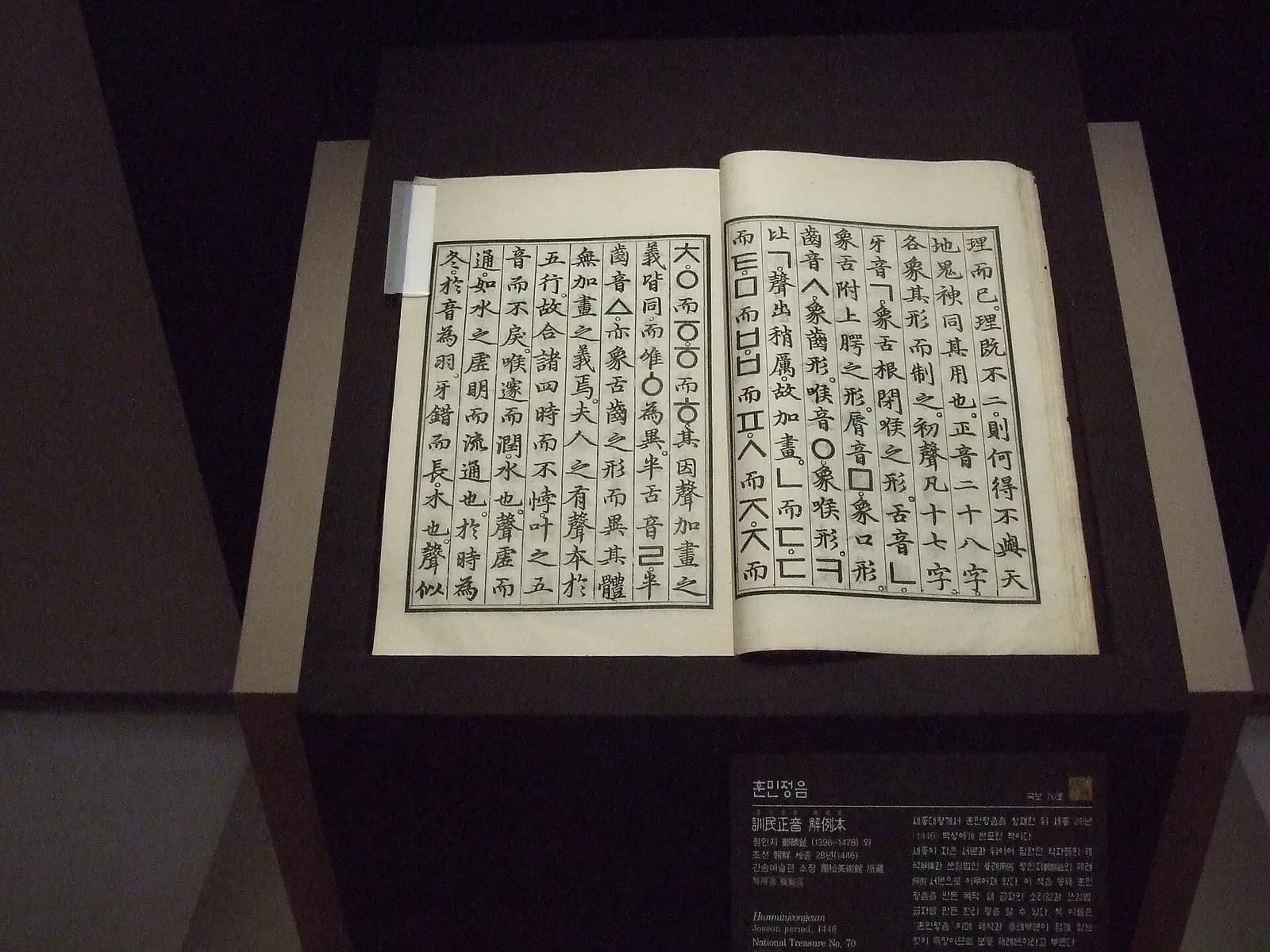

License details
Hunminjeongeumhaerye.jpg — Kbarends at English Wikipedia
· Resized · WebP conversion1. The Barrier of Hanja and a Vision for Universal Literacy
Before Hangul, Chinese characters were used for writing in Korea. Differences between Korean and Chinese made expressing Korean speech through these characters difficult for many people. The Hunminjeongeum preface describes making written expression more accessible as a reason for the new script.
King Sejong completed the script in 1443. The Hunminjeongeum, explaining its purpose and principles, was published in 1446. These dates refer to different events: creation and publication.
The original system had 28 basic letters: 17 consonants and 11 vowels. Modern Hangul uses 24 basic letters: 14 consonants and 10 vowels, which combine to form further letters and syllables. The two counts describe different stages of the alphabet.
2. Articulatory Linguistics: Letters Shaped by the Human Mouth
Linguists worldwide regard Hangul as an intellectual masterpiece because the consonant shapes are not arbitrary symbols: they are geometric schematics of the speech organs when producing the sound.
The letter ㄱ depicts the tongue root blocking the throat; ㄴ mimics the tongue tip touching the upper palate; ㅁ draws the closed lips; ㅅ represents the teeth; and ㅇ traces the open throat. Stronger aspirated sounds were created systematically by adding single strokes to these base shapes.
Vowels embody philosophical cosmology through three foundational elements: a dot representing the round Heavens (•), a horizontal stroke representing the flat Earth (ㅡ), and a vertical line representing upright Humanity (ㅣ) standing between them.
3. Hangul’s Use Across the Centuries
The arrival of Hangul did not immediately end the use of Chinese characters. National Hangeul Museum exhibitions trace its widening use in books, letters and daily life over subsequent centuries.
Hangul became an official national script in 1894, centuries after its creation. Creating a writing system, spreading its use and adopting it officially were distinct historical developments.
4. From Basic Letters to Everyday Writing
Hangul letters are grouped into syllable blocks: an initial consonant, a vowel and, where present, a final consonant. What looks like one square symbol to a beginner is a combination of letters with distinct sounds and roles.
Learners can begin with the basic letters and then practise reading syllable blocks in names and signs. National Hangeul Museum resources connect the shapes and sounds of letters with their history.
Sources & Official Archives
🧭 继续探索韩国
紧密关联的深度故事,助您更全面地了解韩国的过去与现在:
三国风云与统一新罗:民族融合与庆州千年黄金帝国
How the dynamic rivalry of northern cavalry, southwestern elegance, and southeastern discipline forged a unified Korean civilization.
庆州:没有围墙的露天博物馆与新罗千年黄金古都
A journey into Korea’s royal soul: ancient grassy tumuli mounds, Bulguksa Temple, Cheomseongdae observatory, and the magical Donggung Palace pond.
韩国现代生活图鉴:全天候极致安全、超速外卖与零小费明码实价文化
Practical context for visitors and residents: cafe customs, delivery services and tipping etiquette.